Fasting for Life by Francis E. Umesiri
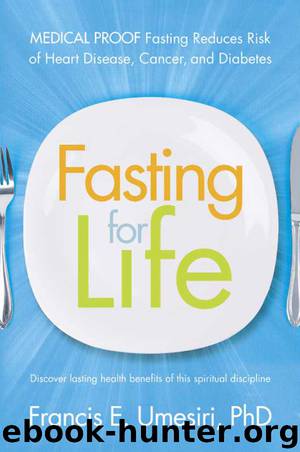
Author:Francis E. Umesiri
Language: eng
Format: epub
Publisher: Charisma House
Published: 2015-11-17T16:00:00+00:00
A sustainable approach
Before discussing various fasting plans, I want to examine how to approach choosing a fasting program that is right for you. It is your responsibility to choose the kind of fasting that works for you in the long run. This is what I call fasting for life: the kind of lifestyle that is both sustainable and beneficial in the long term. Also, by “fasting for life,” I mean fasting in such a way that you experience fullness of life, complete wellness, and the “all-may-go-well-with-you” kind of life John wrote about. Resist the temptation to become obsessed with one component of the various blessings of fasting.
Fasting can be useful for improving health span and reducing our risk of such chronic diseases as diabetes, cancer, and neurodegenerative diseases. But fasting is also a powerful spiritual tool that helps us stay in tune with God and enjoy a full, balanced life. Both aspects of fasting are important, but in my opinion to shift focus from spiritual to solely health will be a mistake. Fasting will help you lose weight; in almost all the studies referenced in the first section, nearly all the subjects involved in each study did so. However, to refocus fasting efforts just to lose weight is, to say the least, myopic. Fast in such a way that you maximize fasting’s health, mental, and spiritual benefits. After all, it is all about attitude, which is why you must choose a sustainable plan. Don’t become too ambitious and decide to fast for forty days when you have not yet done two days. Take it one step at a time. Start now to cut back on your calorie intake and to intentionally fast from time to time, but avoid going to extremes.
There is a good reason for describing fasting as a “discipline.” Every discipline requires training, practice, consistency, and a measure of sacrifice. Fasting is a spiritual sacrifice, one that is self-imposed. There is a cost—denying yourself food at a regular rate is not going to be a lot of fun. This is probably why many people don’t fast; it takes discipline. You have to choose to make this sacrifice.
This is important because some people may read about these benefits of fasting discussed earlier and feel motivated enough to fast periodically. That is a wonderful thing. But you have to realize that fasting is in some ways a painful practice, and mentally commit to do it anyway. I think the initial sacrifice involved in fasting seems to come as something of a shock to people who are just starting. Often, this initial pain results in the discontinuation of the program. Whenever you start a fast, your body will likely go into a kind of “revolt.” Denying it a constant supply of food and chemicals is too much of a sacrifice, leaving you feeling weak, tired, and maybe even dizzy. But as everyone who fasts can tell you, that all-consuming feeling of pain and weakness gets better as you persist.
Remember, biomedical scientists
Download
This site does not store any files on its server. We only index and link to content provided by other sites. Please contact the content providers to delete copyright contents if any and email us, we'll remove relevant links or contents immediately.
How to Be a Bawse: A Guide to Conquering Life by Lilly Singh(7466)
Deep Work by Cal Newport(7059)
The Longevity Diet by Valter Longo(5057)
The Fat Loss Plan by Joe Wicks(4903)
The Four-Pack Revolution by Chael Sonnen & Ryan Parsons(3967)
The Ultimate Bodybuilding Cookbook by Kendall Lou Schmidt(3927)
The French Women Don't Get Fat Cookbook by Mireille Guiliano(3651)
Not a Diet Book by James Smith(3409)
Super Food Family Classics by Jamie Oliver(3400)
Factfulness_Ten Reasons We're Wrong About the World_and Why Things Are Better Than You Think by Hans Rosling(3230)
Turn Up Your Fat Burn! by Alyssa Shaffer(3213)
Self-Esteem by Matthew McKay & Patrick Fanning(3134)
Tom Kerridge's Dopamine Diet: My low-carb, stay-happy way to lose weight by Kerridge Tom(3094)
Body Love by Kelly LeVeque(3053)
The Unbecoming of Mara Dyer by Michelle Hodkin(3030)
Tone Your Tummy Type by Denise Austin(2836)
The Fat Chance Cookbook by Robert H. Lustig(2831)
LL Cool J's Platinum 360 Diet and Lifestyle by LL Cool J(2725)
Men's Health Best by Men's Health Magazine(2587)
